Followers
Friday, January 19, 2018
A Salad Bowl and Things in my Mother's House
Edna St. Vincent Millay: From the postcard collection
All I can see from where I stood
Was three long mountains and a wood;
I turned and looked the other way,
And saw three islands in a bay. . .
and I am 15 again, holding that teal-green volume from the town library in my hands, sitting outside, reading reading, longing to write myself, longing to express the things I'm starting to feel about the world, longing to grow up.

I'm grown up now, and I've learned, been told, that Millay was not a great American poet but merely a good one, a popular poet, very, in her time. I know from that big fat absorbing biography of her that I read, Savage Beauty, published in 2002, that later in life she had a terrible drug addiction (she kept careful records of what she took so we know exactly how terrible), that she died after falling downstairs at Steepletop, her home in rural New York, at the age of 58, alone, the year after her husband died. But her lyric verse still charms me, still transports me back to my girlhood, and I still love the magnolia-framed photograph of her, a moment captured in time, how pretty she was with her hair swept back in a loose bun, some of the magnolia blossoms not quite yet open.
Friday, October 28, 2016
Nasty Women, New England Graveyards, & the Common Scold
Such a nasty woman. After hearing those words directed at the first woman presidential candidate ever nominated by a major party, the issue of the criticizing and the denigrating and the putting down of women, especially opinionated and outspoken women, was much on my mind. It was on my mind when Dan and I strolled around the South Burying Ground in Concord, Massachusetts on a misty Saturday morning before flying out of Logan Airport to return home to North Carolina.
As we wandered about, soberly reading the inscriptions, the gravestone of Mrs. Zeruiah Miles, the wife of Mr. Charles Miles, who departed this life July ye 12th 1757 in the 30th year of her age, caught my eye. Whoever authored the inscription (Mr. Charles himself?) selected these words to sum up the essence of Goodwife Miles: she was of a pleasant temper a respectful wife and of a good conduct and behaviour in her life.
Sarah Miles, perhaps a relation, who died the year before Zeruiah, lies in the Burying Ground as well. The wife of Deacon Samuel Miles, she is remembered as a prudent and virtuous wife a kind and instructive mother and was conscientious and virtuous in her life and conversation. Looked at from one angle, I get it, not so terrible to be remembered as kind and pleasant and good and virtuous. May we all strive to be these things, women and men alike. But the problem is that is all women are supposed to be, all we better be, good/kind/pleasant, not to mention conscientious in conversation and virtuous in pretty much everything, all the time, no matter what the situation, no matter what is happening. We were, and are, harshly judged for speaking up or speaking out. We are not praised the way men are for leadership or strength or intellectual accomplishment. The so-called feminine virtues are the ones most rewarded and reinforced. I think of the three most unforgettable Puritan female names I've seen on Vermont gravestones: SILENCE, SUBMIT, and THANKFUL. A message to the women of the world: Be silent, submit to male authority, and be thankful for that. Amen.
As we continued our walk around Concord, I recalled something I learned in law school -- I may not have been actually taught about this, but rather might have come upon it leafing through my Black's Law Dictionary (bought as a 1L, still in my office), or during some of my feminist reading, namely, the tort of a common scold. A tort is a civil -- as opposed to a criminal -- legal wrong. An aggrieved party can take someone to civil court for such a wrong and get relief. But what, exactly, is a common scold?
Dictionary.com lays it right on the line: in early common law, a habitually rude and brawling woman whose conduct was subject to punishment as a public nuisance. Or this: A woman who, in consequence of her boisterous, disorderly, and quarrelsome tongue, is a public nuisance to the neighborhood. Wiki weighs in thus: a troublesome and angry woman who breaks the public peace by habitually arguing and quarreling with her neighbors. The Latin name for the offense, communis rixatrix, has the telltale feminine -ix ending, signaling that the offender could only be a woman. A nasty woman.
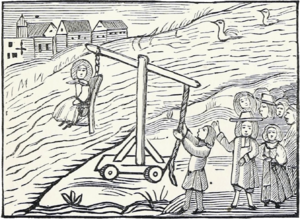
The fact that such an offense exists at all is bad enough, but but things start to really heat up when we learn about the penalties for this offense, the ducking stool (also called a cucking stool) and the bridle or brank. Although sometimes used for men, especially dishonest tradesmen, the ducking stool was specifically categorized as a form of "women's punishment" and consisted of a wooden chair attached to a plank that was used to plunge the unlucky rixatrix in water. In short, an instrument of public humiliation and social censure:
And the scold's bridle? Nothing subtle about that baby. This humiliating device was a locked metal mask or head cage that contained a tab that fit in the mouth to inhibit talking, nothing short of a form of torture. Here's a picture. Such a nasty woman.

Finally, although many sources call the tort obsolete, let the record reflect that in 1972 (yes, nineteen hundred and seventy two), in the Garden State of New Jersey, a woman was indicted for being a common scold, "a troublesome and angry woman, who, by brawling and wrangling among her neighbors, breaks the public peace, increases discord, and becomes a nuisance to the neighborhood." State v. Palendrano, 120 N.J. Super. 336, 293 A. 2d 747 (1972). (Palendrano is a criminal case and the literature generally describes the scold as a civil wrong, but hey, this is a blog post and not a law review article, so I'm not sure why.) You can read the full opinion here -- it's not especially long, but (spoiler alert!) I am relieved to reveal that Judge McGann concluded that "being a common scold is no longer a crime." McGann found the law of communis rixatrix to be unconstitutionally vague under the 14th Amendment and also discriminatory against women in violation of that amendment's Equal Protection Clause. The judge also threw in some free speech language and a note about cruel and unusual punishment for good measure and dismissed the common scold count of the indictment. I didn't do any definitive research (remember, not a law review article) but suffice it to say I hope that was the last time a woman was indicted for being a common scold.
Such a nasty woman. There is nothing innocuous and, sadly, nothing new about those truly nasty words, which attacked Hillary Clinton on the basis of her gender alone, which at their core attack women for being women, for being themselves. But sisterhood is powerful and the fight goes on. Our voices shall not be silenced.
Monday, August 29, 2016
The Saga of Tooth #15 or, A Pity Party for One
For some reason you have to go to the bar at Vin Rouge to order takeout pâté, so I sat morosely on a stool surrounded by happy people drinking and noshing on their steak frites (the dentist, again, on my weekend diet, albeit sympathetically: "think of french fries as too crunchy"). It was busy and the wait was long and I kept thinking about the bottle of chilled white wine in the fridge. When I got home, ravenous, I transferred the whole thick slice of chicken-y, pork-y pâté to a favorite plate, along with the Dijon mustard and cornichons that came with it, uncorked the bottle of cirò bianco -- from Calabria, like my paternal grandparents -- poured myself a generous pour, and polished off the whole decadently delicious portion of pâté, nibbling judiciously on the cornichons with the right side of my mouth, hopefully safely removed from the tooth in question -- #15 in the dental lexicon -- the far-back upper molar on the left side of my mouth.
Once the pâté was history, I took the ripe avocado sitting on the counter, mashed it, minced some red onion, and mixed it in with the avocado along with some lemon juice, salt, and pepper. Voilà, guacamole for one, the perfect second course at my pity party. I wolfed that down too, whereupon it was time to sip just a little more cirò, see what Nate is up to, remember that we are going to see our son and daughter-in-law in less than two weeks and that our daughter and son-in-law live just around the corner from us and that we are taking them to Vin Rouge to celebrate his birthday this coming Friday night. I might even share some pâté. Maybe my pity party is not so pitiful after all.
Sunday, July 24, 2016
Lynchburg, Poplar Forest, Mr. Jefferson and Me
When the University of Virginia is your alma mater, you hear a lot about its founder, Thomas Jefferson. Not just its founder, but its architect, the man who designed the classically beautiful Rotunda and the Lawn, "the Academical Village," that graduates, including me, spend a lifetime reminiscing about, this special place where they spent their college years. Mr. J. also personally designed his famous Charlottesville home, a plantation really, the one on the back of the Jefferson nickel, the "little mountain": Monticello. So unique, such "masterpieces of human creative genius" are the Academical Village and Monticello, that they have been jointly named a UNESCO World Heritage Site. Not bad for a self-taught architect.


Sunday, July 3, 2016
A Luscious Plum Torte for Summer
I have two posts in mind that I hope to commit to writing this weekend, one somewhat reflective in nature, the other more cheering. Let's start with the cheering -- hence food-related -- post.
A few days ago my son Quentin texted me "Is there a way you can send your new york times plum cake recipe? I kind of want it for my b day." My immediate reply: "Nothing would make me happier!"
The plum cake Quentin was referring to is Marian Burros's Plum Torte, a recipe originally published in 1982. It was so popular that in those pre-internet days it was apparently published annually for a number of years. My mother clipped her own copy from the Times in 1984, in an article entitled Purple Plums: From Tree to Torte. (The link does not include the cute graphic in the original article, not to mention that the formatting of the recipe is a mess. The text, however, is charming.) My photocopy of the clipping includes my mother's handwritten notation "TRY -- Looks easy." I can't remember if Mom actually ever made it (she has clipped many a recipe that never made it to table, but come to think of it, so have I), but at some point I initiated myself into the wonder of this simple and delicious torte. I know that my husband has made it a number of times as well.
A variation of Burros's plum torte also appears in Richard Sax's Classic Home Desserts. Sax rechristens it "All-Time Best Summer Fruit Torte" and turns it into a peach or nectarine and blueberry cake, with Burros's 12 purple plums merely listed at the end of the recipe as a variation. Sax does, however, give Burros full credit for the original recipe, noting that it first appeared in her 1960 The Easy But Elegant Cookbook. Sax also suggests the felicitous addition of vanilla, but erroneously lists a tablespoon of baking powder rather than Burros's teaspoon. Trust me on this; it should be a teaspoon.
This might be a good place to summarize my cook's notes:
As to ingredients, it's definitely a teaspoon of baking powder, not a tablespoon, and thumbs up to Sax's teaspoon of vanilla. Use of cinnamon and lemon juice depends on the fruit and your personal taste. As to the pan, either 8 or 9 inches is fine; ten seems big to me. Burros specifies a spring-form pan, which I think best, as you can easily remove the cake, with its lovely pattern of plums on top, to a serving plate, but a regular round cake pan (as Sax uses) also works. But honestly, if you don't have at least one spring-form pan, you really should, as there are many not-especially-pricey models out there. My Kaiser brand pans were bought years ago, were downright inexpensive, not even nonstick, and work fine. Finally, as many reviewers noted, Burros' cooking time of one hour is excessive. Sax says 45 minutes; I'd at least take a look after 30. Here's a picture of Kaiser's "basic" spring-form pan like the ones I own.
I was also delighted to discover in my search that many food-related websites and other bloggers have sung the praises of this plain, buttery, plum-or-fruit-laden treat. A good photo of the finished product is found at Kvell in the Kitchen. Looks like The Kveller didn't use a spring-form, although she does engage in some pretty rhapsodic prose about the torte itself.
And finally, I don't want to be a total purist here; other fruits of course can be substituted as plums are not always easy to find, not to mention seasonal. As one reviewer noted: "Use any kind of nice fruit or berries, just make sure that they are firm,
otherwise they can release too much juice during baking." Almond extract instead of vanilla doesn't sound like a bad idea either, nor does adding a little almond flour, but these are ideas I have not yet tried out. Last but not least: whipped cream is an optional but fine finishing touch.
So happy birthday, dearest Quentin! I only wish I could be there to make and share a plum torte with you and Mary and Dino and Bradley and Dad. Can I at least buy you a gift of a spring-form pan?
Wednesday, June 15, 2016
The Tenth Anniversary of a Great Meal
Recently I was doing a bit of decluttering (although I have not yet perused The Life Changing Magic of Tidying Up) which included finding a number of notebooks, canvas bags, and the like loaded with endless scribbled drafts of poems and essays. In one little book I find, inter alia, the following:
In the bed
my sunburned husband snores
21 years married
an anniversary of no
particular importance
~~~~~~~~~~~~~~~~~~~
and later on:
His head is served up
on a huge white collar
his forehead, too, is white.
His lips are serious, sealed,
His mustache narrow.
His eyes point sideways
but somehow pin us in his gaze.
He holds a small book in one hand
atop a brown Bible
one finger a bookmark.
He is seated.
He is standing up.
His robes are flowing toward us
black and white
marked with a spidery cross.
This poem (which I have edited a bit as I transcribed it here) is about El Greco's portrait of Fray Hortensio Felix Paravicino in Boston's Museum of Fine Arts, which I have long loved to distraction, and who actually once came to visit me in Durham at Duke's Nasher Museum of Art as part of an exhibit, which meant I was able to go to the museum obsessively to get my fill of Fray Felix (as I always call him in my head because I like the alliteration) during his stay in the Bull City. And in finding this picture below, I also just learned that Fray Felix was himself a poet who dedicated four sonnets to El Greco! How great is that?
The hell with life-changing magic; I'm not getting rid of anything I've written. Maybe one of these days I'll finish Fussy Eater, which starts, " 'Poison peas' my dad always said to me whenever they were served, knowing of my dislike for them."
But I thought this post was supposed to be about the tenth anniversary of a great meal? Ah yes. Well, my notebook also includes some entries from a 2006 trip to Germany and Spain, including the description of a meal the four of us ate on Monday, the 3rd of July, in the Catalan city of Girona. The facilitator of the writing group I was part of at that time had recently been there herself and recommended a restaurant that she said was both excellent and reasonably priced, called Draps. (I'm delighted to report that it appears Draps is still alive and well -- "Draps: A Culinary Experience To Be Shared in Girona!" one recent diner proclaimed -- and affordable -- "at convenient prices!")
On the way to the restaurant, I recorded, we heard nuns singing in their ancient stone convent, the music coming through the window-grill that separates them from the world, and then the clink of silverware on plates as their evening meal was served.
I've written MEAL AT DRAPS at the top of one page. And then I describe the meal:
Water from a little blue glass bottle
2 Spanish wines -- white (slightly effervescent) and red
Cold melon and ham appetizer drink served in a tiny martini glass
3 dishes (which we shared)
Fresh thin ribbons of pasta with shrimp, duck, spinach, and mushrooms served over a bed of lettuce and radicchio
Grilled vegetables -- peppers, eggplant etc. (oh what were the et cetera?) on a tart of puff pastry, topped with strong goat cheese sprinkled with black sesame seeds, drizzled with some sort of vinaigrette
"El Pop" -- roundish pieces of octopus served on small square pieces of potato (one piece of octopus per potato) covered with red olive oil, sprinkled with paprika. Bread to soak up every last drop of the red, paprika-scented oil (must have been smoked paprika, pimenton)
2 decaf Illys (for Dino and me as I recall), a brandy for Dan, and two desserts:
El Pecat ("The Sin"): a dark chocolate pudding on a pool of creme anglaise
Crema Catalana -- a sort of Spanish Crème Brûlée topped with caramel ice cream and cinnamon sauce
As I recall, the restaurant itself was quite moderne and stylish but I cannot really recall the details -- why did I not write about that? But then I turn the page; I did!
Water glasses were curved and multicolored
Tables were square dark brown wood with fresh pale brown table runners and napkins (which were folded into long narrow rectangles)
The plates were white and in unusual shapes (I had drawn a sort of curved crescent with squared ends to demonstrate one of them). Below the crescent, I wrote: "We laughed and ate and talked about Dalí," as we had gone to the Dalí Museum in Figueres earlier that day.
"We leave at midnight. The upstairs of the restaurant is still filled with people."
What a memory! What a meal!