Followers

Saturday, May 26, 2018

Goodbye, Philip Roth


As a reader, a writer, a woman, and a feminist, I can't seem to pass up this opportunity to weigh in on Philip Roth, who died this week at the age of 85. Not that I am a Rothian scholar -- I read only a modest fraction of his considerable oeuvre: Goodbye Columbus (maybe just the title story), Portnoy, per my reading list The Prague Orgy back in 1985 (no memory of that book whatsoever), and more memorably his two slim volumes of memoir, Patrimony and The Facts.  I also devoured the post-divorce tell-all by his second wife Claire Bloom, Leaving a Doll's House, where to quote the New York Times review and to put it mildly, she paints him as a "self-centered misogynist." But plenty of ink has already been spilled on the subject of Philip Roth and women, particularly Jewish women (see, for example, Philip Roth Hated Jewish Women) so I don't feel much need to add my voice to that chorus. And anyway, how can anyone possibly compete with Vivian Gornick's observation "If in Bellow misogyny was like seeping bile, in Roth it was lava pouring forth from a volcano"??? Not even gonna try.

But I did want to say that in a world where the voices of men still are the voices that are listened to, where the perspective of men still predominates, I remain more interested in the voices of women (not disinterested in the voices of men, just more interested in the voices of women). So maybe it is not exactly surprising that not long before Roth's death I was going through my overstuffed folder of reviews and clippings of books I might want to read someday and came upon a "bibliography of books by and about jewish women" -- hipster lack of capitalization theirs -- that I tore from a 1983 issue of the "radical feminist periodical" (you nailed it Wiki) Off Our Backs.


I've read a number of books from that list over the years, but on that day I was drawn to Jewish Grandmothers, edited by Sydelle Kramer and Jenny Masur, and published by Boston's Beacon Press in 1976. According to OOB the book contains "Ten autobiographical accounts of Jewish women who came to America early in the twentieth century" with "each chapter a refutation of the stereotype."

My hunch that that no local library would have a copy of this little-known book turned out to be correct, so I ordered a used copy online, which I was in the process of reading when my phone sent me a push with the news of Roth's death. What irony -- in fact, the inside flap of the dust jacket actually refers to Alexander Portnoy himself:
These ten women, immigrants from Eastern Europe who came to America between the turn of the century and the 1920s, now give a public so long accustomed to Portnoy's complaint a chance to hear the whole story.


  Back cover of Jewish Grandmothers

So thank you Fannie Shapiro, Sarah Rothman, Rose Soskin, Pearl Moscowitz, Katya Govsky, Anuta Sharrow, Mollie Linker, Beatrice Pollock, Ida Richter, and Ruth Katz for raising your voices and sharing your stories. As Rothman puts it in her very first sentence: "I was thinking, if I could only write a book, I would have so much to tell."

And while I'm at it, thank you, too, Kveller, for your article this week Ten Writers Not Named Philip Roth Capturing the Female American Jewish Experience.

So many women's voices, so much to tell.

Jewish writers


Friday, January 19, 2018

A Salad Bowl and Things in my Mother's House

Throughout my childhood the salad at any special occasion was served in a bowl shaped like a giant lettuce leaf, stamped "Made in Portugal" on the bottom.


And now that my mother has moved into an apartment at a retirement community and the children (there are four of us but it is mostly my sister and me) are taking things left behind in the house, the salad bowl is now in my own home, sitting atop the low bookcase Dan built in our little home office, visible to me every day. 

Unimaginable really that it should be in my house at all, so completely do I connect it with my parents, with their life together. It should be on the dining room table at 342 North Columbus Avenue in Mount Vernon, the room with the flocked velvet red and gold wallpaper, with my Aunt Rosie or Aunt Frances sitting in those ornate carved chairs my mother loved so well, chairs that none of us, we must confess, wanted, and are now in the hands of a consignor, waiting to be sold. Italian-Americans usually served the salad after the meal, right on the same plate from which they just eaten their macaroni or lasagna, the oil and red wine vinegar mixing with the gravy, which is what we always called tomato sauce until everyone got more Americanized. And that is how salad was served from this bowl, right onto the dinner plate, before coffee and dessert.

I told my mother I had taken the bowl. "Oh good," she said. (She is unfailingly pleased whenever we take something from her house. In her perfect world, every last chair, lamp, cup, napkin, tablecloth and plate would go to her children and grandchildren.) "Didn't you say you got it as an engagement or wedding gift?" I encourage her to remember. "Yes," she said, adding ruefully, "but I can't remember which." I press on. "And who gave it to you? " Not an Italian, right? It looks so Anglo," Anglo being an all-purpose term for anything un-Italian-American. No, my mother quickly agrees, not an Italian. "Didn't you tell me that Sherman Lichtman and his wife gave it to you and dad?" Dr. Lichtman was a Jewish dentist my Aunt Marie worked for as a dental hygienist, back when a hygienist was simply a young woman with a high school degree who learned on the job. But my mother is not sure, and the certain identity of the occasion and the giver, more than 60 years in the past, have in fact slipped away forever. 

My mother took good care of the bowl. Ceramics are notoriously vulnerable to chipping, yet the bowl has only a single tiny chip barely visible on its rim. I have not used it yet, can't bring myself to, not sure I will. So there it sits in my house, on top of the bookcase, between two glass vases and a stack of CDs, where it should, and and at the same time shouldn't, be.

Edna St. Vincent Millay: From the postcard collection

There is a pinhole at the top of my postcard of the young Edna St. Vincent Millay, framed by a magnolia, her head in profile, in a dress that must be linen because of its wonderful wrinkling, square mother-of-pearl buttons down the front. 


The pinhole. I think I tacked the card onto a bulletin board in my first-year dorm room when I was in college. And before college and the postcard and the pinhole, one summer in high school, in Vermont, I read through the entire Collected Poems of Edna St. Vincent Millay, straight through, one after another, all 800-something pages. I loved the fact she was from Maine, that she first achieved fame at the tender age of 19 with her poem Renascence, which won a prize and was published in 1912. Of course it rhymed, all 200 lines worth, somewhat purple-prosy, but I loved it then and I love it now; I can still recite a fair bit of the beginning, in my head, in places like the dentist's chair:

     All I can see from where I stood
     Was three long mountains and a wood;
     I turned and looked the other way,
     And saw three islands in a bay. . .

and I am 15 again, holding that teal-green volume from the town library in my hands, sitting outside, reading reading, longing to write myself, longing to express the things I'm starting to feel about the world, longing to grow up.

Image result for Collected Poems of Edna St. Vincent Millay

I'm grown up now, and I've learned, been told, that Millay was not a great American poet but merely a good one, a popular poet, very, in her time. I know from that big fat absorbing biography of her that I read, Savage Beauty, published in 2002, that later in life she had a terrible drug addiction (she kept careful records of what she took so we know exactly how terrible), that she died after falling downstairs at Steepletop, her home in rural New York, at the age of 58, alone, the year after her husband died. But her lyric verse still charms me, still transports me back to my girlhood, and I still love the magnolia-framed photograph of her, a moment captured in time, how pretty she was with her hair swept back in a loose bun, some of the magnolia blossoms not quite yet open.


Friday, October 28, 2016

Nasty Women, New England Graveyards, & the Common Scold

I was still on vacation in Vermont when presidential debate #3 took place. Dan and I agreed that we had zero interest in watching it, although I occasionally checked Facebook to see what my cohorts were saying and to get a secondhand sense of what was going on. As 10:30 and the end of the allotted 90 minutes approached, my curiosity got the better of me and I live-streamed the last couple of minutes on my phone, in time to see Donald Trump lean into his microphone and to hear him speak over Hillary Clinton: "Such a nasty woman." Such a nasty woman. Much eloquent journalistic ink has been subsequently spilled over this offensive, misogynistic phrase but I knew even in the moment that it was BAD and was going to get a lot of (well-deserved) negative press.

Such a nasty woman. After hearing those words directed at the first woman presidential candidate ever nominated by a major party, the issue of the criticizing and the denigrating and the putting down of women, especially opinionated and outspoken women, was much on my mind. It was on my mind when Dan and I strolled around the South Burying Ground in Concord, Massachusetts on a misty Saturday morning before flying out of Logan Airport to return home to North Carolina. 


As we wandered about, soberly reading the inscriptions, the gravestone of Mrs. Zeruiah Miles, the wife of Mr. Charles Miles, who departed this life July ye 12th 1757 in the 30th year of her age, caught my eye. Whoever authored the inscription (Mr. Charles himself?) selected these words to sum up the essence of Goodwife Miles: she was of a pleasant temper a respectful wife and of a good conduct and behaviour in her life.


Sarah Miles, perhaps a relation, who died the year before Zeruiah, lies in the Burying Ground as well. The wife of Deacon Samuel Miles, she is remembered as a prudent and virtuous wife a kind and instructive mother and was conscientious and virtuous in her life and conversation.  Looked at from one angle, I get it, not so terrible to be remembered as kind and pleasant and good and virtuous. May we all strive to be these things, women and men alike. But the problem is that is all women are supposed to be, all we better be, good/kind/pleasant, not to mention conscientious in conversation and virtuous in pretty much everything, all the time, no matter what the situation, no matter what is happening. We were, and are, harshly judged for speaking up or speaking out. We are not praised the way men are for leadership or strength or intellectual accomplishment. The so-called feminine virtues are the ones most rewarded and reinforced. I think of the three most unforgettable Puritan female names I've seen on Vermont gravestones: SILENCE, SUBMIT, and THANKFUL.  A message to the women of the world: Be silent, submit to male authority, and be thankful for that. Amen.


As we continued our walk around Concord, I recalled something I learned in law school -- I may not have been actually taught about this, but rather might have come upon it leafing through my Black's Law Dictionary (bought as a 1L, still in my office), or during some of my feminist reading, namely, the tort of a common scold. A tort is a civil -- as opposed to a criminal -- legal wrong. An aggrieved party can take someone to civil court for such a wrong and get relief. But what, exactly, is a common scold?  


Dictionary.com lays it right on the line: in early common law, a habitually rude and brawling woman whose conduct was subject to punishment as a public nuisance. Or this: A woman who, in consequence of her boisterous, disorderly, and quarrelsome tongue, is a public nuisance to the neighborhood. Wiki weighs in thus: a troublesome and angry woman who breaks the public peace by habitually arguing and quarreling with her neighbors. The Latin name for the offense, communis rixatrix, has the telltale feminine -ix ending, signaling that the offender could only be a woman. A nasty woman.

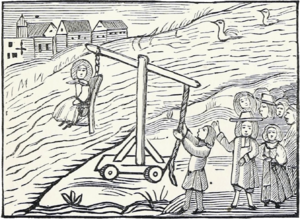
The fact that such an offense exists at all is bad enough, but but things start to really heat up when we learn about the penalties for this offense, the ducking stool (also called a cucking stool) and the bridle or brank. Although sometimes used for men, especially dishonest tradesmen, the ducking stool was specifically categorized as a form of "women's punishment" and consisted of a wooden chair attached to a plank that was used to plunge the unlucky rixatrix in water. In short, an instrument of public humiliation and social censure:


And the scold's bridle? Nothing subtle about that baby. This humiliating device was a locked metal mask or head cage that contained a tab that fit in the mouth to inhibit talking, nothing short of a form of torture. Here's a picture. Such a nasty woman.


Finally, although many sources call the tort obsolete, let the record reflect that in 1972 (yes, nineteen hundred and seventy two), in the Garden State of New Jersey, a woman was indicted for being a common scold, "a troublesome and angry woman, who, by brawling and wrangling among her neighbors, breaks the public peace, increases discord, and becomes a nuisance to the neighborhood." State v. Palendrano, 120 N.J. Super. 336, 293 A. 2d 747 (1972). (Palendrano is a criminal case and the literature generally describes the scold as a civil wrong, but hey, this is a blog post and not a law review article, so I'm not sure why.) You can read the full opinion here -- it's not especially long, but (spoiler alert!) I am relieved to reveal that Judge McGann concluded that "being a common scold is no longer a crime." McGann found the law of communis rixatrix to be unconstitutionally vague under the 14th Amendment and also discriminatory against women in violation of that amendment's Equal Protection Clause. The judge also threw in some free speech language and a note about cruel and unusual punishment for good measure and dismissed the common scold count of the indictment. I didn't do any definitive research (remember, not a law review article) but suffice it to say I hope that was the last time a woman was indicted for being a common scold.

Such a nasty woman. There is nothing innocuous and, sadly, nothing new about those truly nasty words, which attacked Hillary Clinton on the basis of her gender alone, which at their core attack women for being women, for being themselves. But sisterhood is powerful and the fight goes on. Our voices shall not be silenced.


Monday, August 29, 2016

The Saga of Tooth #15 or, A Pity Party for One

Thursday's root canal (the need for which was discovered when the dentist took X-rays for a temporary crown preparatory to a permanent crown) morphed into Friday night's cracked and fallen-off temporary crown -- guess I got a little too aggressive with that braised rotisserie chicken and kale.  Several after-hours phone calls and texts with the admittedly extremely responsive and compassionate endodontist and on-call dentist, including a couple of texted glamour shots of the interior of my mouth (including a fleck of tomato skin on the roof thereof -- appetizing!) led to the conclusion that everything is pretty much stable  -- if you define "stable" as the ground-down, jagged, sharp, exposed remnants of what was once my tooth -- and can be dealt with Monday, when a new temporary crown (still preparatory to a permanent crown) can be fitted and popped over the whole sorry mess. I saved the broken pieces of crown snugly wrapped up in a piece of aluminum foil kind of the way children keep their baby teeth -- I'm not entirely sure why. And oh yes, be careful with food, the dentist said sympathetically, I know it's not fun, but eat mostly soft foods. 

On Saturday morning I told my husband that I was basically doing okay and that he should go forward with his plans to visit his sister and younger brother overnight. . .I'm sure he was relieved, and anyway, this was going to be a pity party for one, and two would be a crowd. I uploaded a new novella on my Nook (Richard Russo's Nate in Venice), ran a few errands, went to the Y (where I started reading Nate), had a phone conference with a recent graduate regarding the merits of a job offer, and decided to go to the 5:30 PM mass so that I could loll in bed on Sunday morning as a sort of pity-party aftermath. My lunch was the Silver Palate's broccoli puree, made by Dan the day of the root canal (and a soothing favorite of my father after his cancer diagnosis) followed by some hummus. Later, as I sat in church mentally composing a short Harris-Teeter shopping list, I remembered that HT is across the street from Vin Rouge, a pretty authentic French bistro considering we are in Durham, North Carolina, and their delightful country pâté is nothing if not soft.


For some reason you have to go to the bar at Vin Rouge to order takeout pâté, so I sat morosely on a stool surrounded by happy people drinking and noshing on their steak frites (the dentist, again, on my weekend diet, albeit sympathetically: "think of french fries as too crunchy").  It was busy and the wait was long and I kept thinking about the bottle of chilled white wine in the fridge. When I got home, ravenous, I transferred the whole thick slice of chicken-y, pork-y pâté to a favorite plate, along with the Dijon mustard and cornichons that came with it, uncorked the bottle of cirò bianco -- from Calabria, like my paternal grandparents -- poured myself a generous pour, and polished off the whole decadently delicious portion of pâté, nibbling judiciously on the cornichons with the right side of my mouth, hopefully safely removed from the tooth in question -- #15 in the dental lexicon -- the far-back upper molar on the left side of my mouth.


Once the pâté was history, I took the ripe avocado sitting on the counter, mashed it, minced some red onion, and mixed it in with the avocado along with some lemon juice, salt, and pepper. Voilà, guacamole for one, the perfect second course at my pity party. I wolfed that down too, whereupon it was time to sip just a little more cirò, see what Nate is up to, remember that we are going to see our son and daughter-in-law in less than two weeks and that our daughter and son-in-law live just around the corner from us and that we are taking them to Vin Rouge to celebrate his birthday this coming Friday night. I might even share some pâté.  Maybe my pity party is not so pitiful after all.

Sunday, July 24, 2016

Lynchburg, Poplar Forest, Mr. Jefferson and Me

When the University of Virginia is your alma mater, you hear a lot about its founder, Thomas Jefferson. Not just its founder, but its architect, the man who designed the classically beautiful Rotunda and the Lawn, "the Academical Village," that graduates, including me, spend a lifetime reminiscing about, this special place where they spent their college years. Mr. J. also personally designed his famous Charlottesville home, a plantation really, the one on the back of the Jefferson nickel, the "little mountain": Monticello. So unique, such "masterpieces of human creative genius" are the Academical Village and Monticello, that they have been jointly named a UNESCO World Heritage Site. Not bad for a self-taught architect.

I did not set foot on the Grounds* of The University* until the day I arrived for first-year* orientation in 1974 (more common back then, to go to a college you had never seen), and although I can't remember for sure if my parents took us to Monticello during my childhood, it wasn't long after starting college that I visited there and started learning about Jefferson's innovations and inventions -- the seven-day clock in the hallway, the polygraph that allowed him to make a copy of every letter he wrote, his alcove bed, the nifty revolving bookstand. And I didn't just go there once or twice. Every time family or friends came to visit, they were eager to see Monticello as well, and I used to joke I had been there so many times I could give the tour as well as any of the guides. I do not, however, remember any mention of slavery.

[*At UVa students do not say campus or quad, they say "Grounds," because that is what Mr. Jefferson called it. And students are never referred to as freshmen, sophomores, juniors, and seniors, but first-, second-, third-, and fourth-year, because Mr. J. felt that these four years were but the beginning of a lifetime of learning. We also like to say "The University" a lot. Yeah, I know, pretty pretentious.]

I don't know when I first heard of Poplar Forest. Located near Lynchburg, Virginia, Poplar Forest was Jefferson's country home -- again, plantation really -- used in his later years as a retreat, his pied-a-terre.

The Poplar Forest (and also the Monticello) websites cover the history of Poplar Forest quite thoroughly, but in brief, Jefferson and his wife Martha inherited the plantation upon her father's death in 1773. In the early years, Jefferson manged the plantation -- it mostly grew tobacco -- from afar, but in 1781 the Jefferson family left Monticello and stayed at Poplar Forest for two months, possibly in the overseer's cabin, to avoid capture by the British.  That was thought to be Martha's only trip to the plantation, as she died later the same year. After her death, Jefferson continued in the role of absent landowner, with overseers managing the plantation, and enslaved laborers performing the work.

At some point Mr. J. decided to design a country getaway there. In 1806, during his presidency, Jefferson traveled to Poplar Forest to supervise the laying of the cornerstone for what was to become the one-story, brick, octagonal dwelling you can visit today. After he left office in 1809, although Monticello remained his primary residence, Jefferson began visiting Poplar Forest several times a year, a practice he continued until the age of 80, three years before his death in 1826. Each visit lasted between two weeks and two months, as the trip from Monticello to Poplar Forest, which takes only an hour and a half by car today, took two days by horseback and three by carriage.

As important as Poplar Forest was to Jefferson, there are reasons for its obscurity. It was sold by Jefferson's grandson Francis Eppes in 1828, only two years after Jefferson's death (Francis and his wife moved, of all places, to Tallahassee).  The house burned in 1845 (thank goodness for stone foundations and a brick exterior), was substantially remodeled, and remained in private hands until 1983, when the Thomas Jefferson Foundation bought the property and undertook the daunting -- and expensive -- task of restoration. Thus, it is only in recent years that it has finally been open to visitors, and even today the restoration is still ongoing and hardly complete.

When our nephew Chris took a job in Lynchburg and moved there with his then-fiancée-now-wife Kata, it seemed like the perfect excuse to combine a visit with them and a trip to Poplar Forest. Although Dan and I actually saw Chris and Kata in Lynchburg twice en route to other places, when they had lived in Lynchburg less than a year Chris took another job and they moved again before we had a chance to execute the plan. But the seed was planted, and I was committed to seeing Poplar Forest. My husband is as much of a history geek as I am, and it took little persuading to talk him into an overnight to Lynchburg, which is, after all, not even 2 1/2 hours from our home in Durham.

Poplar Forest ended up being the last thing we did on our 30-hour excursion. During our preparatory research, Dan noticed that the last home of Patrick Henry, Red Hill, was basically on the way to Lynchburg, and we decided to make that our first stop. A lovely, peaceful, place, especially on a sunny, hot July afternoon without many tourists in evidence. "Give me liberty or give me death!" "Liberty, the greatest of all earthly blessings -- give us that precious jewel and you may take everything else!" The guy could really turn a phrase.

In Henry's time, we learned, Red Hill encompassed about 3,000 acres. Another plantation. Our tour guide pointed out where the slave cabins once were located. As we have learned in other places, they were generally not visible from the main house and are virtually never still standing, these humble, roughly-built cabins never intended to stand the test of time. We squinted, looking into the distance. Liberty, the greatest of all earthly blessings.  With the midafternoon sun blazing, we did not walk up the hill to bear witness. But at least this history is no longer ignored, invisible. Red Hill's website has a section, Slavery at Red Hill.  It includes an excerpt of a letter written by Henry in 1773, where he says of the fact he is a slaveowner, owns human beings: "I will not, and cannot justify it."

The next morning, since our hotel was in downtown Lynchburg and Poplar Forest vaguely on the way back to Durham, we decided to first stop at the Lynchburg Museum, located in the old courthouse. The exhibit in the large entrance hall on the main floor is a history of Lynchburg. In a section called An Upward Struggle, I read:
State-sanctioned segregation increasingly became an issue in the 1950s. Schools were separate, parks were separate, seating in theaters was separate, and the separateness was not equal.

Near those words is a photograph of Clarence W. Seay, assured, looking ahead, a hand in the pocket of his topcoat. The caption states that he was the principal of Lynchburg's Dunbar High School, an all-black, segregated high school, for 30 years, and that in 1970, he became the first African-American member of the Lynchburg City Council since the 1880s.


As I gazed at the photograph, I thought about how, on the way into the museum, we stopped by a statue facing the courthouse, a statue erected by the United Daughters of the Confederacy in 1890, "to commemorate the heroism of our Confederate soldiers." 1890, after Reconstruction, after the Yankees finally decamped, when blacks had the vote and even were elected to the City Council. Time to put up a statue, a statue complete with a time capsule filled with Confederate currency, photographs of local veterans, and some hair from Traveller, Robert E. Lee's horse. Time for Jim Crow. Time to wait nearly a century for the next African-American to serve on the City Council. And the Confederate Soldier still stands, on the top of Monument Terrace, in 2016.


Poplar Forest at last. Hot again. We eat our picnic lunch in pleasant solitude in the shade, looking at a grove of trees, grateful for a breeze.


The plantation was about 5,000 acres in Jefferson's day, and even with today's reduced size, is a thing of beauty, of symmetry, with the house placed in the center of a circular curtilage.

And there are still poplars on the property.


So yes, I loved the house, both back


and front.


I loved the light-filled interior (sorry, no pictures allowed), but the internet yields one of Jefferson's recliner -- a reproduction, not the original -- where he sat and contemplated the world.


Evan was a great tour guide and with only two others on our tour, we got to ask lots of questions.

But unlike my first trip to Monticello, Jefferson the slaveowner weighed deeply on my consciousness throughout our time at Poplar Forest. Again, on the tour itself, in the exhibits, on the website, in the brochure, as best as it can from the available historical evidence, this story is now being told. So we now, at last, can say their names, names inventoried and written in Mr. Jefferson's own hand: The Hubbards, Hannah and Jame and Phill and Billy. Bess's Caesar. Fanny's Rachael. Cate's Sally. Suck's Stephen. All endowed by their Creator with certain inalienable rights, among them life, liberty, and the pursuit of happiness. Dinah. Lucinda. Armistead. John. Isaac. Briley. Prince. Melinda. Milly. Daniel. Flora. Hercules. Abby. Nace. And so many more.

Sunday, July 3, 2016

A Luscious Plum Torte for Summer

I have two posts in mind that I hope to commit to writing this weekend, one somewhat reflective in nature, the other more cheering. Let's start with the cheering -- hence food-related  -- post. 

A few days ago my son Quentin texted me "Is there a way you can send your new york times plum cake recipe? I kind of want it for my b day."  My immediate reply:  "Nothing would make me happier!"

The plum cake Quentin was referring to is Marian Burros's Plum Torte, a recipe originally published in 1982. It was so popular that in those pre-internet days it was apparently published annually for a number of years. My mother clipped her own copy from the Times in 1984, in an article entitled Purple Plums: From Tree to Torte. (The link does not include the cute graphic in the original article, not to mention that the formatting of the recipe is a mess. The text, however, is charming.)  My photocopy of the clipping includes my mother's handwritten notation "TRY -- Looks easy." I can't remember if Mom actually ever made it (she has clipped many a recipe that never made it to table, but come to think of it, so have I), but at some point I initiated myself into the wonder of this simple and delicious torte. I know that my husband has made it a number of times as well.

A variation of Burros's plum torte also appears in Richard Sax's Classic Home Desserts. Sax rechristens it "All-Time Best Summer Fruit Torte" and turns it into a peach or nectarine and blueberry cake, with Burros's 12 purple plums merely listed at the end of the recipe as a variation. Sax does, however, give Burros full credit for the original recipe, noting that it first appeared in her 1960 The Easy But Elegant Cookbook. Sax also suggests the felicitous addition of vanilla, but erroneously lists a tablespoon of baking powder rather than Burros's teaspoon.  Trust me on this; it should be a teaspoon.

This might be a good place to summarize my cook's notes:
As to ingredients, it's definitely a teaspoon of baking powder, not a tablespoon, and thumbs up to Sax's teaspoon of vanilla. Use of cinnamon and lemon juice depends on the fruit and your personal taste. As to the pan, either 8 or 9 inches is fine; ten seems big to me. Burros specifies a spring-form pan, which I think best, as you can easily remove the cake, with its lovely pattern of plums on top, to a serving plate, but a regular round cake pan (as Sax uses) also works. But honestly, if you don't have at least one spring-form pan, you really should, as there are many not-especially-pricey models out there. My Kaiser brand pans were bought years ago, were downright inexpensive, not even nonstick, and work fine. Finally, as many reviewers noted, Burros' cooking time of one hour is excessive. Sax says 45 minutes; I'd at least take a look after 30.  Here's a picture of Kaiser's "basic" spring-form pan like the ones I own.


I was also delighted to discover in my search that many food-related websites and other bloggers have sung the praises of this plain, buttery, plum-or-fruit-laden treat. A good photo of the finished product is found at Kvell in the Kitchen. Looks like The Kveller didn't use a spring-form, although she does engage in some pretty rhapsodic prose about the torte itself.

And finally, I don't want to be a total purist here; other fruits of course can be substituted as plums are not always easy to find, not to mention seasonal. As one reviewer noted: "Use any kind of nice fruit or berries, just make sure that they are firm, otherwise they can release too much juice during baking." Almond extract instead of vanilla doesn't sound like a bad idea either, nor does adding a little almond flour, but these are ideas I have not yet tried out. Last but not least: whipped cream is an optional but fine finishing touch.

So happy birthday, dearest Quentin! I only wish I could be there to make and share a plum torte with you and Mary and Dino and Bradley and Dad. Can I at least buy you a gift of a spring-form pan?