Followers

Friday, March 27, 2020

Cooking and Dreaming Italian-Style

I own too many cookbooks, way too many cookbooks. I admit it. I plead guilty. Uncle, uncle! I knew I was in deep trouble a number of years ago when I decided to put just my favorite everyday cookbooks together in a bookcase convenient to the kitchen. There were about 80. And I read them every single day, especially now, when I'm trying to limit my exposure to scary news, and dream about cooking, dream about food.

The past few days I've been browsing in my Italian cookbooks (How many total in that category? No idea. Let's just say a lot and leave it at that.) I can't remember when, exactly, my parents, my mother really, gave me Lydia Cooks from the Heart of Italy: A Feast of 175 Regional Recipes, published in 2009.


Just like the title says, the recipes are arranged by region, although not every region is represented. Calabria (where my father's parents were from) is there, although Campania (where my mom's parents were from and where Naples is located) is not. Not to worry though, my good friend Sandy Rappaport filled that gap some time ago with food maven Arthur Schwartz's tome Naples at Table ("Neapolitan cooking is 'what the whole world knows as Italian cooking'. . .two of the most popular foods in the world -- spaghetti with tomato sauce and pizza -- are Neapolitan. It speaks of the poverty that drove thousands of people from Naples and its countryside to seek opportunity elsewhere. . .") I also own several other cookbooks by the fabulous Mr. Schwartz (New York City Food, Soup Suppers, and What To Cook), but I digress. . .


Here is the full-color glossy that precedes the section of Calabrese recipes in Lydia's book, although Angelo and Maria came from Calabria's interior, not the seacoast. And if you really want to take a deep dive into Calabrian cuisine, there's always My Calabria, also from my collection:


Anyway, as I was paging through the Heart of Italy, a recipe from the Valle D'Aosta (a tiny region in northwest Italy bordered by France and Switzerland, those are some pretty swell neighbors) caught my eye: Roasted Pepper & Olive Salad with Fontina. It features roasted yellow bell peppers, large green olives, and Fontina cheese, preferably from the Valle itself, all slivered, over which is poured a dressing made with -- wait for it -- some heavy cream along with mustard and cider vinegar.  Lydia says you can replace the cream with olive oil (not terrible) but concedes that the cream gives the dressing "a velvety texture." 

Fontina. As one website lyrically rhapsodizes, At the feet of the Alps, in the Italian Aosta valley, lie the lush meadows upon which red-pied Valdostana cows provide the milk needed to produce Fontina. Incredibly rich and creamy, the flavors of this cheese are sweet and pungent, unveiling tones of butter and roasted nuts as it lingers on your palate.  I mean, my God!

So just for today I dream about Fontina cheese, about that salad, on a warm spring evening much like tonight, with a crisp Pinot Grigio, some Italian bread, and the company of foodie friends, carefree, shall we once again be carefree, shall Italy once again be La Bell'Italia, safe and beautiful, my ancestral land?


Thursday, December 12, 2019

In Defense of the Singular They


Image result for they

This is a text of an email I just sent to Laura Graham, Professor of Legal Writing and Director of Legal Analysis, Writing and Research at Wake Forest University School of Law. The North Carolina Lawyer is a monthly publication of the North Carolina Bar Association. 

I am writing in response to your column in the November 2019 issue of the North Carolina Lawyer.  I am a licensed attorney who has been practicing law in North Carolina since 1982, and I have served as the Director of the Career Development Office at the University of North Carolina School of Law since 2005.

I was deeply (deeply!) disappointed to read your column on the singular they. While you accept the use of the term for non-binary persons (tacitly acknowledging that language changes and the formerly incorrect and ungrammatical can become acceptable and correct), you resist its use when it does not refer to a singular non-binary person (refusing to accept that language changes and the formerly incorrect and ungrammatical can become acceptable and correct). It is, to my mind, and the mind of many others, a plainly outmoded and sexist construction, and defending its use is increasingly, well, indefensible. As quoted in the NPR piece below “When you utter ‘he,’ you always bring a male to mind.” It’s that simple.  

For starters, the use of the singular they in English is not new at all, but has been well-established in both spoken language, and yes, written language too, for centuries. Merriam-Webster, in declaring “they” the word of the year in 2019, noted that “English famously lacks a gender-neutral singular pronoun to correspond neatly with singular pronouns like everyone or someone, and as a consequence they has been used for this purpose for over 600 years.

Although singular they has a long and venerable history both in spoken and written language, as noted by this NPR piece from 2016: “It shows up in Shakespeare, Dickens and George Bernard Shaw. Jane Austen was always saying things like ‘everybody has their failing,’ . . .the Victorian grammarians made it a matter of schoolroom dogma that one could only say "Everybody has his failing," with the understanding that ‘he’ stood in for both sexes” – the masculine embracing the feminine, as it were. The NPR piece has a link to a blog posting which contains a detailed history of the use of the singular they and the resistance thereto, which resistance really got serious during the second wave of feminism – happily in my lifetime! – noting that the prohibition against the generic they

wasn't really discredited until the 1970s, when the second-wave feminists made the generic masculine the paradigm of sexism in language. Male critics ridiculed their complaints as a "libspeak tantrum" and accused them of suffering from "pronoun envy." But most writers now realize that the so-called gender-neutral "he" is anything but. Nobody would ever say, "Every candidate thanked his spouse, including Hillary." When you utter "he," you always bring a male to mind.

My early-morning research on a busy day (would that I had even more time for this important subject) indicates that, as you say a fair number of your colleagues have put it, “the train has left the station” when it comes to the use of the singular they, not only in speech, but in an increasing acceptance in formal writing and style guides.  Yes, a phrase or sentence can sometimes be recast (generally by using the plural) to avoid the singular they, but the only reason to insist that every use of the singular they be recast or rewritten is based upon the belief that the singular they is “wrong” in some sort of immutable way. However, language is not immutable and unchanging, but rather, as the Linguistic Society of America put it in Is English Changing?,  Language is always changing, evolving, and adapting to the needs of its users.”

Why is this so important? Language and words help form our beliefs and images and concepts of the world. To go back to where I started, When you utter ‘he,’ you always bring a male to mind,” reinforcing the patriarchal belief that men are more important than women. (As a 16th century grammarian so neatly put it, “the masculine gender is more worthy than the feminine. . .“)  I am proud to say that I have done my small part to depict the world in a more egalitarian way and have consistently used the generic singular they not only in speech, but in my writing, both informal and formal – including all my legal writing – for as long as I can remember.

Change happens because we make it happen. I urge you to rethink your resistance to this issue and write in a way, and encourage your students to write in a way, that sends the message that the feminine gender is, always, as worthy as the masculine.

Saturday, October 6, 2018

A political poem in political times


What To Do

Read Mary Oliver over and over. Read Jane Eyre, Laura Ingalls Wilder, Nancy Drew, the book by Louise Nevelson where she says I think that there is such a thing as energy, creation overflowing. Make apple cake with raisins and spices. Change the towels. Change the sheets. Change the locks. Go to Duke Gardens and see if the water lilies are still in bloom, if the Japanese bridge is still painted red. Call Coach and complain about the bag where the zipper placket tore. Repot the houseplants. Eat salted cashews, yogurt with stewed blueberries, dark chocolate. Say a rosary. Sweep the floor. Find the prayer card of Saint Lucy. Purge shoes and earrings and scarves. Look at the photographs of one grandmother a widow, the other in a housedress, neither of them smiling. Listen to Barbra Streisand sing I’d Rather be Blue in Funny Girl. Listen to Fanny Brice singing it first in 1928. Go to see Gaspard & Dancers with Jane. Walk with Lynn. Walk with Sally. Walk with April. Keep walking. Look at Georgia O’Keeffe’s White Flower, blowing up in your face. Remember when Betty Friedan debated Phyllis Schlafly, how Betty lunged forward and rose up from her chair. Remember hearing Adrienne Rich, Tillie Olsen, Gloria Steinem, Nikki Giovanni. Remember Ethel Merman belting out the revival of Annie Get Your Gun. Remember how Annie missed the shot to get her man. Remember being told don’t let the boys hear you say that and it’s so nice when that first one is a boy. Remember pushing out children into the world. Remember the truth you are telling all the time. Remember how much you had hoped things would change. Remember it, remember it all, and rage on, rage on, rage on, rage on, rage on.

Saturday, May 26, 2018

Goodbye, Philip Roth


As a reader, a writer, a woman, and a feminist, I can't seem to pass up this opportunity to weigh in on Philip Roth, who died this week at the age of 85. Not that I am a Rothian scholar -- I read only a modest fraction of his considerable oeuvre: Goodbye Columbus (maybe just the title story), Portnoy, per my reading list The Prague Orgy back in 1985 (no memory of that book whatsoever), and more memorably his two slim volumes of memoir, Patrimony and The Facts.  I also devoured the post-divorce tell-all by his second wife Claire Bloom, Leaving a Doll's House, where to quote the New York Times review and to put it mildly, she paints him as a "self-centered misogynist." But plenty of ink has already been spilled on the subject of Philip Roth and women, particularly Jewish women (see, for example, Philip Roth Hated Jewish Women) so I don't feel much need to add my voice to that chorus. And anyway, how can anyone possibly compete with Vivian Gornick's observation "If in Bellow misogyny was like seeping bile, in Roth it was lava pouring forth from a volcano"??? Not even gonna try.

But I did want to say that in a world where the voices of men still are the voices that are listened to, where the perspective of men still predominates, I remain more interested in the voices of women (not disinterested in the voices of men, just more interested in the voices of women). So maybe it is not exactly surprising that not long before Roth's death I was going through my overstuffed folder of reviews and clippings of books I might want to read someday and came upon a "bibliography of books by and about jewish women" -- hipster lack of capitalization theirs -- that I tore from a 1983 issue of the "radical feminist periodical" (you nailed it Wiki) Off Our Backs.


I've read a number of books from that list over the years, but on that day I was drawn to Jewish Grandmothers, edited by Sydelle Kramer and Jenny Masur, and published by Boston's Beacon Press in 1976. According to OOB the book contains "Ten autobiographical accounts of Jewish women who came to America early in the twentieth century" with "each chapter a refutation of the stereotype."

My hunch that that no local library would have a copy of this little-known book turned out to be correct, so I ordered a used copy online, which I was in the process of reading when my phone sent me a push with the news of Roth's death. What irony -- in fact, the inside flap of the dust jacket actually refers to Alexander Portnoy himself:
These ten women, immigrants from Eastern Europe who came to America between the turn of the century and the 1920s, now give a public so long accustomed to Portnoy's complaint a chance to hear the whole story.


  Back cover of Jewish Grandmothers

So thank you Fannie Shapiro, Sarah Rothman, Rose Soskin, Pearl Moscowitz, Katya Govsky, Anuta Sharrow, Mollie Linker, Beatrice Pollock, Ida Richter, and Ruth Katz for raising your voices and sharing your stories. As Rothman puts it in her very first sentence: "I was thinking, if I could only write a book, I would have so much to tell."

And while I'm at it, thank you, too, Kveller, for your article this week Ten Writers Not Named Philip Roth Capturing the Female American Jewish Experience.

So many women's voices, so much to tell.

Jewish writers


Friday, January 19, 2018

A Salad Bowl and Things in my Mother's House

Throughout my childhood the salad at any special occasion was served in a bowl shaped like a giant lettuce leaf, stamped "Made in Portugal" on the bottom.


And now that my mother has moved into an apartment at a retirement community and the children (there are four of us but it is mostly my sister and me) are taking things left behind in the house, the salad bowl is now in my own home, sitting atop the low bookcase Dan built in our little home office, visible to me every day. 

Unimaginable really that it should be in my house at all, so completely do I connect it with my parents, with their life together. It should be on the dining room table at 342 North Columbus Avenue in Mount Vernon, the room with the flocked velvet red and gold wallpaper, with my Aunt Rosie or Aunt Frances sitting in those ornate carved chairs my mother loved so well, chairs that none of us, we must confess, wanted, and are now in the hands of a consignor, waiting to be sold. Italian-Americans usually served the salad after the meal, right on the same plate from which they just eaten their macaroni or lasagna, the oil and red wine vinegar mixing with the gravy, which is what we always called tomato sauce until everyone got more Americanized. And that is how salad was served from this bowl, right onto the dinner plate, before coffee and dessert.

I told my mother I had taken the bowl. "Oh good," she said. (She is unfailingly pleased whenever we take something from her house. In her perfect world, every last chair, lamp, cup, napkin, tablecloth and plate would go to her children and grandchildren.) "Didn't you say you got it as an engagement or wedding gift?" I encourage her to remember. "Yes," she said, adding ruefully, "but I can't remember which." I press on. "And who gave it to you? " Not an Italian, right? It looks so Anglo," Anglo being an all-purpose term for anything un-Italian-American. No, my mother quickly agrees, not an Italian. "Didn't you tell me that Sherman Lichtman and his wife gave it to you and dad?" Dr. Lichtman was a Jewish dentist my Aunt Marie worked for as a dental hygienist, back when a hygienist was simply a young woman with a high school degree who learned on the job. But my mother is not sure, and the certain identity of the occasion and the giver, more than 60 years in the past, have in fact slipped away forever. 

My mother took good care of the bowl. Ceramics are notoriously vulnerable to chipping, yet the bowl has only a single tiny chip barely visible on its rim. I have not used it yet, can't bring myself to, not sure I will. So there it sits in my house, on top of the bookcase, between two glass vases and a stack of CDs, where it should, and and at the same time shouldn't, be.

Edna St. Vincent Millay: From the postcard collection

There is a pinhole at the top of my postcard of the young Edna St. Vincent Millay, framed by a magnolia, her head in profile, in a dress that must be linen because of its wonderful wrinkling, square mother-of-pearl buttons down the front. 


The pinhole. I think I tacked the card onto a bulletin board in my first-year dorm room when I was in college. And before college and the postcard and the pinhole, one summer in high school, in Vermont, I read through the entire Collected Poems of Edna St. Vincent Millay, straight through, one after another, all 800-something pages. I loved the fact she was from Maine, that she first achieved fame at the tender age of 19 with her poem Renascence, which won a prize and was published in 1912. Of course it rhymed, all 200 lines worth, somewhat purple-prosy, but I loved it then and I love it now; I can still recite a fair bit of the beginning, in my head, in places like the dentist's chair:

     All I can see from where I stood
     Was three long mountains and a wood;
     I turned and looked the other way,
     And saw three islands in a bay. . .

and I am 15 again, holding that teal-green volume from the town library in my hands, sitting outside, reading reading, longing to write myself, longing to express the things I'm starting to feel about the world, longing to grow up.

Image result for Collected Poems of Edna St. Vincent Millay

I'm grown up now, and I've learned, been told, that Millay was not a great American poet but merely a good one, a popular poet, very, in her time. I know from that big fat absorbing biography of her that I read, Savage Beauty, published in 2002, that later in life she had a terrible drug addiction (she kept careful records of what she took so we know exactly how terrible), that she died after falling downstairs at Steepletop, her home in rural New York, at the age of 58, alone, the year after her husband died. But her lyric verse still charms me, still transports me back to my girlhood, and I still love the magnolia-framed photograph of her, a moment captured in time, how pretty she was with her hair swept back in a loose bun, some of the magnolia blossoms not quite yet open.


Friday, October 28, 2016

Nasty Women, New England Graveyards, & the Common Scold

I was still on vacation in Vermont when presidential debate #3 took place. Dan and I agreed that we had zero interest in watching it, although I occasionally checked Facebook to see what my cohorts were saying and to get a secondhand sense of what was going on. As 10:30 and the end of the allotted 90 minutes approached, my curiosity got the better of me and I live-streamed the last couple of minutes on my phone, in time to see Donald Trump lean into his microphone and to hear him speak over Hillary Clinton: "Such a nasty woman." Such a nasty woman. Much eloquent journalistic ink has been subsequently spilled over this offensive, misogynistic phrase but I knew even in the moment that it was BAD and was going to get a lot of (well-deserved) negative press.

Such a nasty woman. After hearing those words directed at the first woman presidential candidate ever nominated by a major party, the issue of the criticizing and the denigrating and the putting down of women, especially opinionated and outspoken women, was much on my mind. It was on my mind when Dan and I strolled around the South Burying Ground in Concord, Massachusetts on a misty Saturday morning before flying out of Logan Airport to return home to North Carolina. 


As we wandered about, soberly reading the inscriptions, the gravestone of Mrs. Zeruiah Miles, the wife of Mr. Charles Miles, who departed this life July ye 12th 1757 in the 30th year of her age, caught my eye. Whoever authored the inscription (Mr. Charles himself?) selected these words to sum up the essence of Goodwife Miles: she was of a pleasant temper a respectful wife and of a good conduct and behaviour in her life.


Sarah Miles, perhaps a relation, who died the year before Zeruiah, lies in the Burying Ground as well. The wife of Deacon Samuel Miles, she is remembered as a prudent and virtuous wife a kind and instructive mother and was conscientious and virtuous in her life and conversation.  Looked at from one angle, I get it, not so terrible to be remembered as kind and pleasant and good and virtuous. May we all strive to be these things, women and men alike. But the problem is that is all women are supposed to be, all we better be, good/kind/pleasant, not to mention conscientious in conversation and virtuous in pretty much everything, all the time, no matter what the situation, no matter what is happening. We were, and are, harshly judged for speaking up or speaking out. We are not praised the way men are for leadership or strength or intellectual accomplishment. The so-called feminine virtues are the ones most rewarded and reinforced. I think of the three most unforgettable Puritan female names I've seen on Vermont gravestones: SILENCE, SUBMIT, and THANKFUL.  A message to the women of the world: Be silent, submit to male authority, and be thankful for that. Amen.


As we continued our walk around Concord, I recalled something I learned in law school -- I may not have been actually taught about this, but rather might have come upon it leafing through my Black's Law Dictionary (bought as a 1L, still in my office), or during some of my feminist reading, namely, the tort of a common scold. A tort is a civil -- as opposed to a criminal -- legal wrong. An aggrieved party can take someone to civil court for such a wrong and get relief. But what, exactly, is a common scold?  


Dictionary.com lays it right on the line: in early common law, a habitually rude and brawling woman whose conduct was subject to punishment as a public nuisance. Or this: A woman who, in consequence of her boisterous, disorderly, and quarrelsome tongue, is a public nuisance to the neighborhood. Wiki weighs in thus: a troublesome and angry woman who breaks the public peace by habitually arguing and quarreling with her neighbors. The Latin name for the offense, communis rixatrix, has the telltale feminine -ix ending, signaling that the offender could only be a woman. A nasty woman.

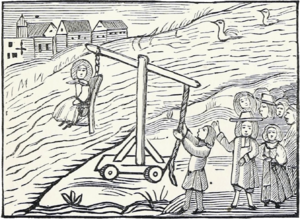
The fact that such an offense exists at all is bad enough, but but things start to really heat up when we learn about the penalties for this offense, the ducking stool (also called a cucking stool) and the bridle or brank. Although sometimes used for men, especially dishonest tradesmen, the ducking stool was specifically categorized as a form of "women's punishment" and consisted of a wooden chair attached to a plank that was used to plunge the unlucky rixatrix in water. In short, an instrument of public humiliation and social censure:


And the scold's bridle? Nothing subtle about that baby. This humiliating device was a locked metal mask or head cage that contained a tab that fit in the mouth to inhibit talking, nothing short of a form of torture. Here's a picture. Such a nasty woman.


Finally, although many sources call the tort obsolete, let the record reflect that in 1972 (yes, nineteen hundred and seventy two), in the Garden State of New Jersey, a woman was indicted for being a common scold, "a troublesome and angry woman, who, by brawling and wrangling among her neighbors, breaks the public peace, increases discord, and becomes a nuisance to the neighborhood." State v. Palendrano, 120 N.J. Super. 336, 293 A. 2d 747 (1972). (Palendrano is a criminal case and the literature generally describes the scold as a civil wrong, but hey, this is a blog post and not a law review article, so I'm not sure why.) You can read the full opinion here -- it's not especially long, but (spoiler alert!) I am relieved to reveal that Judge McGann concluded that "being a common scold is no longer a crime." McGann found the law of communis rixatrix to be unconstitutionally vague under the 14th Amendment and also discriminatory against women in violation of that amendment's Equal Protection Clause. The judge also threw in some free speech language and a note about cruel and unusual punishment for good measure and dismissed the common scold count of the indictment. I didn't do any definitive research (remember, not a law review article) but suffice it to say I hope that was the last time a woman was indicted for being a common scold.

Such a nasty woman. There is nothing innocuous and, sadly, nothing new about those truly nasty words, which attacked Hillary Clinton on the basis of her gender alone, which at their core attack women for being women, for being themselves. But sisterhood is powerful and the fight goes on. Our voices shall not be silenced.